IMB-NAS: Neural Architecture Search for Imbalanced Datasets




Abstract
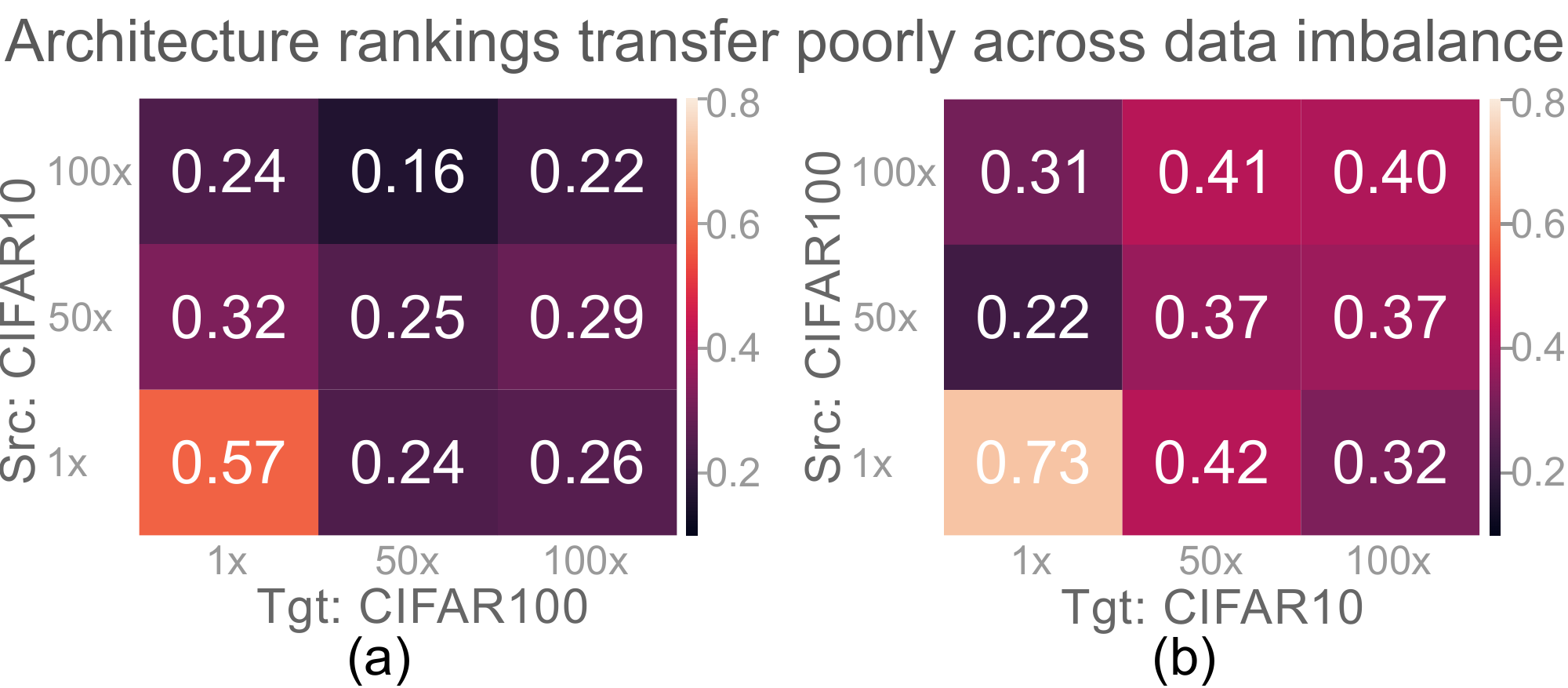
Class imbalance is a ubiquitous phenomenon occurring in real world data distributions. To overcome its detrimental effect on training accurate classifiers, existing work follows three major directions: class re-balancing, information transfer, and representation learning. In this paper, we propose a new and complementary direction for improving performance on long tailed datasets—optimising the backbone architecture through neural architecture search (NAS). We find that an architecture’s accuracy obtained on a balanced dataset is not indicative of good performance on imbalanced ones. This poses the need for a full NAS run on long tailed datasets which can quickly become prohibitively compute intensive. To alleviate this compute burden, we aim to efficiently adapt a NAS super-network from a balanced source dataset to an imbalanced target one. Among several adaptation strategies, we find that the most effective one is to retrain the linear classification head with reweighted loss, while freezing the backbone NAS super-network trained on a balanced source dataset. We perform extensive experiments on multiple datasets and provide concrete insights to optimise architectures for long tailed datasets.
BibTeX
			@article{duggal2022imbnas,
  title={IMB-NAS: Neural Architecture Search for Imbalanced Datasets},
  author={Duggal, Rahul and Peng, Shengyun and Zhou, Hao and Chau, Duen Horng},
  journal={arXiv preprint arXiv:2210.00136},
  year={2022}
}