Non-Robust Features are Not Always Useful in One-Class Classification
 Matthew Lau



 Martin Andreoni


Abstract
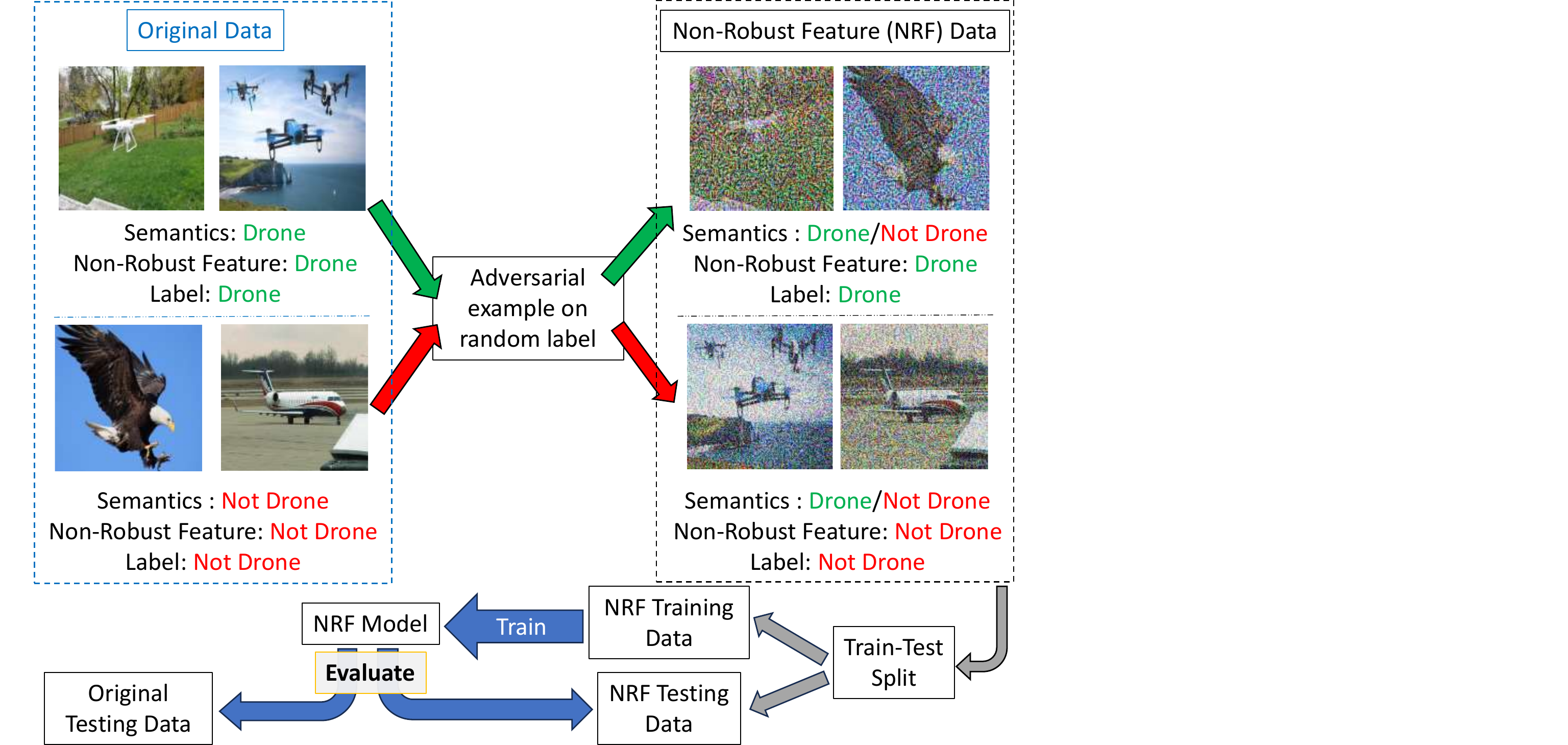
The robustness of machine learning models has been questioned by the existence of adversarial examples. We examine the threat of adversarial examples in practical applications that require lightweight models for one-class classification. Building on Ilyas et al. (2019), we investigate the vulnerability of lightweight one-class classifiers to adversarial attacks and possible reasons for it. Our results show that lightweight one-class classifiers learn features that are not robust (e.g. texture) under stronger attacks. However, unlike in multi-class classification (Ilyas et al., 2019), these non-robust features are not always useful for the one-class task, suggesting that learning these unpredictive and non-robust features is an unwanted consequence of training.
BibTeX
			@article{lau2024nonrobust,
  title={Non-Robust Features are Not Always Useful in One-Class Classification},
  author={Lau, Matthew and Wang, Haoran and Helbling, Alec and Hull, Matthew and Peng, ShengYun and Andreoni, Martin and Lunardi, Willian T. and Lee, Wenke},
  journal={arXiv preprint arXiv:2407.06372},
  year={2024}
}